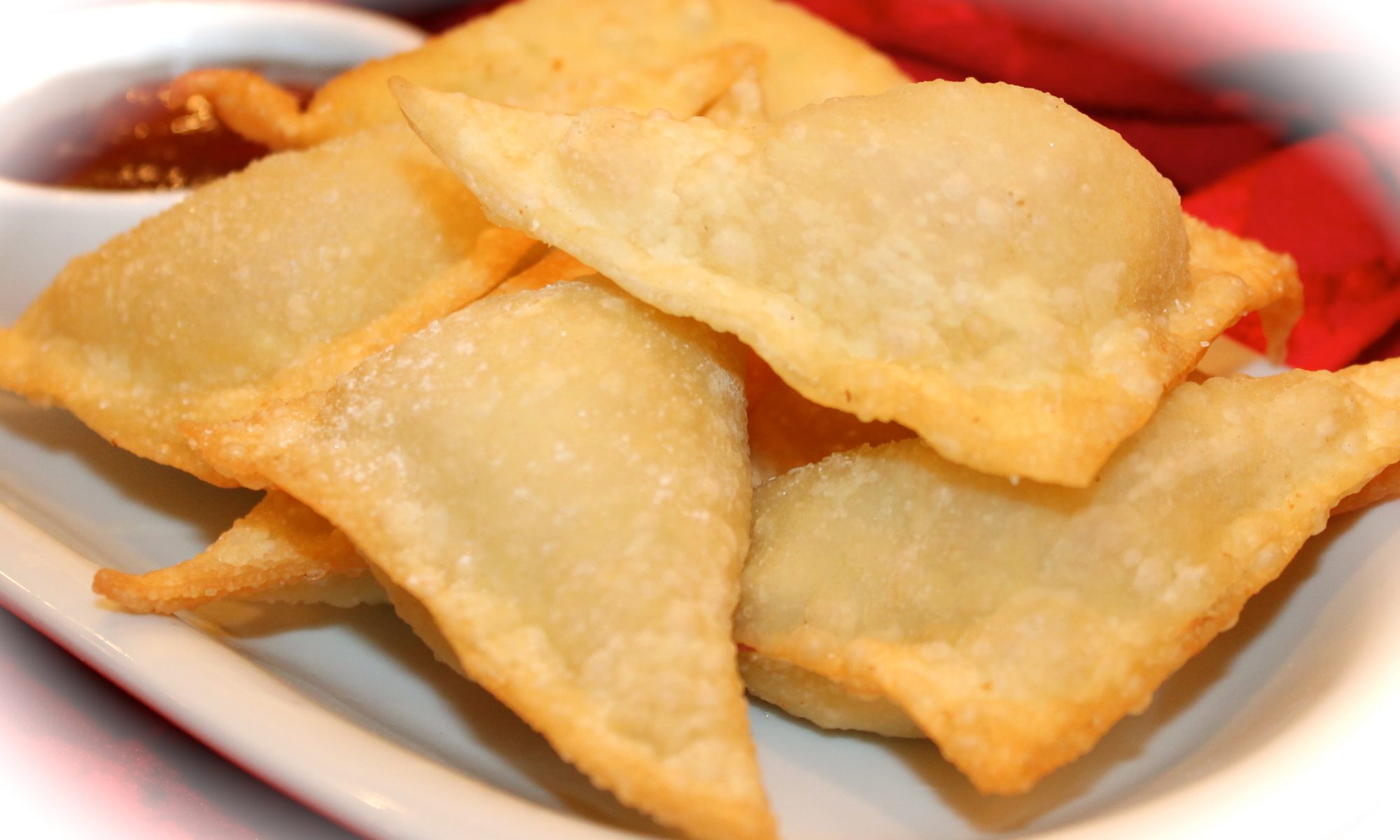
I knew the history growing up around crab rangoon. It wasn’t a very easy to find appetizer, but suddenly I started hearing people talk about it again on YouTube when I suddenly noticed Asian vloggers telling you that it’s not authentic Chinese food. They’re right, it’s authentic San Franciscan food.
I never saw crab rangoon offered at any of the Chinese restaurants in the City and I even started trying to find it on the menus and finally found it at one restaurant in the Outer Sunset. Oddly enough it’s easier to find at the Hawaiian restaurants you’ll find around the Bay Area, but it’s rare at Chinese restaurants.
So here’s the funny thing about all this. While crab rangoon was invented and first served at Trader Vic’s in Emeryville before moving on their locations it’s nearly impossible to find today in San Francisco. Yet when I moved back east to Northampton, Massachusetts every Chinese restaurant sells it. The grocery stores even sell frozen packages of it.
If you have no idea what crab rangoon is [and you’ll quickly see why it’s not authentic Chinese] it’s a fried appetizer that consists of a won-ton skin filled with crab, green onions and…cream cheese. Tastes great in my opinion, but definitely not Chinese. Vic Bergeron took a few liberties when he built his Tiki Bar empire with some of the recipes he introduced.
If you can find it in San Francisco you should try it. I rather like it and you can point out as I do that it’s an authentic San Franciscan dish.
As I travel around San Francisco every day I’ve been noticing changes that aren’t looking very good anymore and I’m beginning to believe the party is over.
People aren’t smiling anymore. People aren’t going out as much anymore. People talk more about how tough it is to live here than how great it is to live here. These are signs that there is a shift in San Francisco happening. I do run into people that aren’t like this, but they tend to be older and in more traditional careers that treat their employees like, well, employees. These are usually older people in their mid 40’s at least who have a job that isn’t usually tied to the tech industry and and have lived here for a long time so they’ve got themselves a good set up. Maybe they were able to buy a house when a person could actually buy a house who wasn’t a millionaire. 20 years ago when my wife and I got married we could have bought a house for $200,000. It would have been small, but it still would have been better than some of the apartments that people are living in now that a little more than oversized porta-potties.
Jobs now in the city are paying less at a time when money is worth less unless you’re a programmer which then makes you salaried with little time off to enjoy the things in the City. Even back in 2010 I was being offered jobs at almost twice what the same jobs are going for today. There are a proliferation of contractor positions, but those jobs treat you more like an employee without the benefits and contractor jobs used to pay better than employee positions because they could drop you at any time. Now contractor positions pay less and give you set hours to work and if you take a sick day then be careful because they’ll probably drop you for not doing your job. That’s not the way contractor positions are supposed to work, but very few people are making enough money to take these companies to court since lawyers aren’t very cheap.
The people I’ve noticed who aren’t suffering as much are construction workers, school bus and muni drivers, firemen, police. These are jobs that are more traditional in that you’re paid reasonably with benefits, time off, paid overtime. Personally I’d give up the free lunch and snacks for an extra couple of bucks an hour because I can bring my lunch or buy it cheaper and it’s usually better tasting and better for me. I met a guy worked for our local garbage collectors. He’s making $27/hour and told me the garbage truck drivers make $47/hour. OK, you have to deal with rats and garbage, but that’s a better living than a graphic designer with a Master’s degree being offer a job for $17/hour by a startup as a contractor [ok, not all are like that, but there’s quite a few out there]. Of course there are the doctors and lawyers which there are a lot of in San Francisco as well as health care workers who also make decent salaries. These are the people who smile now. These are the ones that go out to dinner on the weekends and sometimes even during the week. They have the money and time on their hands to really appreciate the City.
I laughingly remember five years ago when I’d pick up kids fresh out of college who would say things like, My Dad got me an apartment and gave me his credit card and is giving me a year to make it in San Fran. Oh joy, Daddy just paid for a year long spring break and my right hand twitched in a smacking motion because they said San Fran [side note: I would even accept Frisco over San Fran]. These people were always going out to a bar or some nightclub every night of the week and they were always asking for a bottle of water in the mornings because they were so hung over from the night before. These people are gone now. I called them long term tourists because I knew they were going to go back home eventually.
Things like that have to happen in order to keep San Francisco what it is, so while even I am struggling to get by right now I know for me it will eventually get better because I was born and raised here and have been through this before. I can handle it. I know where to get a burrito for less than $15 or not spend $4 or more for toast. I don’t take Uber or Lyft to work everyday or order gourmet artisanal food delivered from one of the new food delivery startups that pops up every other week.
San Francisco will never return to the old days and by old days that depends on your age. My Mom isn’t around anymore to remind me she used to pay 5¢ for a candy bar. I find myself starting to say things like that, but it’s more like I remember going out to a bar with $20 for the evening and coming home with change…and I used to drink a lot.
Change is good, but change can also be painful. Let’s hope this leads to something better in the end.
OK, bad joke maybe, but I’ve been noticing that the next new big thing in San Francisco cuisine is all about cultured butter. Restaurants are making their own like it’s something new that’s never been done before and mixing in bone marrow or herbs or whatever they have laying around in the kitchen. The reality is that it’s not that new, it’s actually been around since people discovered milk comes out of cows and oddly enough it’s pretty easy to make yourself.
Why would I want to make butter? You’re probably saying. You can buy it at the store and if you look hard enough you can sometimes even find cultured butter. This is a bit different though because it’s fresh since you made it yourself and the thing that the restaurant chefs aren’t talking about is that if it’s made here it’s got San Francisco bacteria in it that you can’t find anywhere else. Just like our sourdough bread has it’s own flavor, cultured butter made in San Francisco has it’s own super rich awesome flavor.
I came upon making butter totally by accident actually. I kept hearing about creme fraiche as a new big thing and realized that I didn’t think I had ever tried it before so I had to make some. That part was easy. Here’s what you need:
1 pint heavy cream [not ultra-pasturized]
2 tablespoons plain yogurt with live cultures or cultured buttermilk
1 jar
Yes, it’s that simple. Pour the cream into a bowl and whip in the yogurt with a whisk then pour it into the jar. Here’s the part where people might get a little hincky. Lightly cover the jar and leave it out for 24 hours and you’ve got creme fraiche. The creme thickens up and starts to get a taste that kind of between cream cheese and sour cream. You’re free to stop there and use it anywhere you’d use sour cream. The fun fact with creme fraiche is that it’s higher butterfat content means you can mix it into sauces and it won’t break. I was tossing it on everything just to see where it would be good. Baked potatoes are great. Add a little sugar and pour it onto berries or dessert and it’s great. Mix in herbs for a super rich and wonderful dip for whatever you want to dip in it.
Now for the butter part. You can take your creme fraiche and pour it into a butter churn. Don’t have one? A food processor will work just fine. Turn it on and watch it start to look like beaten whipped cream in a couple of minutes. Let the processor keep going for about 5 minutes and it starts to break up from all that agitation. You’re getting butter and buttermilk. Pour the buttermilk off and add some cold water and run the processor again. The water will wash out more of the buttermilk and you might have to do this a couple of times before the water starts to come out clear. The more buttermilk you can extract the longer it will last.
When you’re done you have cultured butter. The buttermilk you got out of it you can use to make more by adding a couple of tablespoons to more cream or you can make buttermilk pancakes. Part of the culturing comes from the yogurt cultures and part comes from your geographic location, i.e. San Francisco. It’s very high in butterfat like European butter. It’s kind of like a rock when you pull it out of the fridge. You can use it on whatever you like. I personally like it melting into some homemade dinner rolls, but again, I’ve been putting it on just about everything to see where it’s best. I’ve yet to be disappointed. It’s a little bit tangier than regular store bought butter and more than even the store bought cultured butter I’ve tried. I’ve used organic cream from Clover Stornetta or Straus Creamery because they’re local and I know the cows are grass fed so you get more Omega 3’s and all the good stuff that comes with grass fed cow’s milk. At the very least don’t tell anyone how easy it is to make and you can been all food snobby when you tell them that the dish you made incorporates hand made butter from the cream of grass fed cows. That’s a lot of words so that means it’s really good.
Yes, it’s pretty much all saturated fat, but it’s healthy saturated fat so it’s good for you right? Just try it and taste it and you really won’t care. I think I’ve found my last meal that won’t disappoint me.
I used to be poor, not homeless poor, but barely getting by and food was a little difficult to come by some days. One day I found some sausage in the freezer and remembered the old British dish that was popular during WWII called Toad In A Hole.
Essentially the dish is sausage cooked in a yorkshire pudding. It’s a quite filling dish and easy to make. I only needed to feed myself so I ended up creating my own riff on the Toad In A Hole which quickly became nicknamed after a certain comedy music video. Later I posted a picture of it on Facebook making a little joke about naming it Theon after the character in Game of Thrones who had a certain part of his body removed. What I didn’t realize was that my FaceBook post got posted to Twitter and then it started to turn into a little meme with the GoT’s fans. It has since started to be referred to by Theon’s surname of Greyjoy.
Now that people are talking about my little meal I put together I realized that after writing my story about my thoughts on $4 Toast that someone might steal this idea from me. So I’ve decided to explain my little riff on this dish before you can see it on menu’s around San Francisco for $25 when it really is one of the most stupidly easy dishes to make. Here’s how it goes…
First you’ll need a good sausage. Don’t use hot dogs. I’ve tried Italian sausage, but the fennel doesn’t seem to taste right. Typically a pork sausage or something with some extra spice like a chicken with garlic sausage. I’ve tried a lot of sausages and some of them that I thought would work don’t so you’ll have to experiment. Now first you’ll have to make your batter.
Batter
I take 1 egg, a half cup of flour and a half cut of milk and beat the hell out of it with a whisk. Add seasoning and here’s where I’ll leave it up to you. You want the batter to be a bit savory, but I’ll let you figure it out. I’ve got my own combination of things I use to give it flavor and I’m not telling. When you’re done put it in the fridge. You can let it set for a few minutes to overnight even so if you’re going to make a lot of them you can plan ahead.
Sausage & Cooking
I used a 5.75″ x 3″ pan which is the perfect size grease up the pan with olive oil or butter and get the sausage good and coated and throw it into a 450° oven for 5 minutes. Pull it out and pour the batter over it and put it back in the oven for 20 minutes. You’re done.
That’s really all there is to it. It looks a bit like a misshapen hot dog, but tastes a lot better and will fed a guy’s hunger easily. The yorkshire pudding fills out the dish so that you don’t need to eat a lot more than you really need. I’ve spent a lot of time thinking about this and even figured out a way that if I owned a restaurant how to throw it together quick enough to serve up to customers without them having to wait a long time. Since the recipe is so simple you can easily adapt it in many different ways.
So if you happen to be in a restaurant in San Francisco in the near future and see a toad in a hole or greyjoy on the menu you’ll know who’s responsible for it. Now pop it your mouth!
When I first heard someone talk about $4 toast in San Francisco I knew we weren’t talking about Wonder Bread. No one would have the cojones that big to try and sell Wonder Bread for $4, but of course San Francisco has plenty of bloggers with the cojones to make you think that. These rich techies are paying $4-$6 for a slice of toast!!!! Well, yes bread is involved and yes it’s toasted, but that’s pretty much where in ends for the most part.
Where it started is up for discussion, but people usually point to Trouble Coffee out in my hood or The Mill as the originators. They start with inch thick slices of wheat bread and slather it with butter and depending can top it with brown sugar and cinnamon, peanut butter and honey or whatever the hell they’re going to think up next. For a big eater it’s a light breakfast or a decent snack, but for the average person it’s pretty much a meal. It’s got a lot more calories and nutrition than a slice of Wonder Bread for sure.
The owner of Trouble Coffee said it was a comfort food for her because she grew up poor. For me, I was a kid in a middle class household that wasn’t hurting for money too bad and guess what my Grandmother used to make for me as a treat? Toast with lots of butter and brown sugar. Grandma would toss it under the broiler for a few seconds to get that serious caramelized effect that chefs like to go for now. It wasn’t a poor man’s pastry, it was actually more expensive than a donut back then probably because of the huge amounts of butter and stuff my Grandmother would toss on top of it. While most of the ingredients came out of boxes or bags this was home made for my Grandmother. I still like it today, I just never thought of slicing the bread an inch thick first.
My Grandmother would toss lots of stuff on bread that she’d toast. She used to broil cheese on bread and that was her version of a grilled cheese sandwich. I took a cue from her and toast bread then rub garlic on it and toss some chopped up tomatoes or other vegetables and call it lazy man’s bruschetta. Unfortunately for most people in San Francisco today lazy tends to be the norm. Finding a friend who is a foodie that can cook is kind of rare nowadays. Most of what people are spending their money on food wise has been prepared by someone else. Yes I cook so of course I’m going to not understand why other people don’t, but we’re talking about toast here. You can go to a bakery like Boudin and buy a loaf and ask them to cut it thick for you. You take it home, toast it, toss a bunch of stuff on top [if you’re slick you’ll put it under the broiler…] and you’re done.
The only reason there is $4 thick toast is that people don’t bother to do it for themselves. For the people who started selling it I think it’s a good idea. If you’ve never made it or bought it, it is something special. I had a poor period and a friend of mine gave me a 10lb bag of flour and a jar of yeast. That reminded me I knew how to make bread and I never felt hungry and I was able to do some pretty incredible things with it because when you’re hungry your mind sees everything as something you can turn into food [at least if you’re a guy like me.]
Incidentally, the $4 toast, after doing a little search didn’t start in San Francisco. It started in Japan as a breakfast item too. It has scrambled egg on top and is sprinkled with chives and is sold as tamago toast for the equivalent cost of…$4
Looks pretty good and I’ll have to give that a try one of these days now.
Pow! Zing! Bam! The Batkid managed to bring San Francisco together for the first time in a long time. Little Miles Scott did what no other fair or government sponsored event has done. He battled all the foes face to face except for one who hid behind his Twitter account — Eric Mar.
Oh dear. Maybe Eric was having a bad day or something, but seriously? Why the need to take a dump on a little kids day that moved the entire city? If you missed it and I doubt you did, Eric Mar posted a tweet that quickly turned viral and got everyone talking:
“Waiting for Miles the Batkid and wondering how many 1000s of SF kids living off SNAP/FoodStamps could have been fed from the $$.”
OK, at least he’s admitting to being there to grab a little bit of the spot light. He might even have been standing near Miles smiling as he sent the dastardly tweet out to all of his followers. Not so odd is that the tweet has been removed from his feed as if in these modern days of the internet anything you say won’t be archive and held against you at a later date [oh dear, did I really post that in 1994?] Here is an actually screen grab of said tweet:
Uhm, did someone say open mouth and insert foot? Batkid’s day was provided to Miles and the City of San Francisco by a private foundation known as the Make-A-Wish foundation. Miles has leukemia which is remission which is awesome in my book and the fact that Make-A-Wish put something together for Miles that also benefitted the City by helping boost the morale of everyone is a great thing that was much sorely needed.
Last time I checked government didn’t have to power to tell a privately held company what it could and could not do or how to operate. If Eric Mar wants more money to go to SNAP then it would be nice if he would step up to the plate and donate his yearly salary to SNAP instead of telling some other company to do it.
Oh wait, Eric Mar agrees that he can’t tell a private corporation how to operate. I found this little bit about Eric Mar Vs. The Happy Meal from not too long ago:
Is there really enough room in your mouth for both of your feet? While I will agree with Eric Mar that families on food stamps/EBT/SNAP aren’t able to properly feed themselves and their kids, if that’s really such a big deal then you should have found another venue than to bring it up instead of stealing the day from a little kid with leukemia.
Miles is a great kid from what I can see and he’s a fighter to have gotten to where he is today and hopefully when he gets older because of youtube and vimeo he’ll have something to look back on and he can just smile and say, I did a good thing.
Cheers to Miles Scott and the Make-A-Wish foundation for giving the City something to get behind for once.
Soph•ist•ry noun 1. the use of fallacious arguments, esp. with the intention of deceiving.
This is a good word I discovered several years ago and I’m finding as every day goes by that me being into food, that this would make a great title for an article. As many of you know I’ve developed a huge hatred for the words that have now become meaningless such as gourmet and artisanal. Every week the local paper has a taste test where they put several items together to see which brand tastes best. More often than not the cheapest brand tastes the best. The gourmet and artisanal brands don’t tastes right to the people and they would not buy them. This leads me to believe that most people who purchase said items tend to be purchasing the packaging more than the product.
As many of you have heard me say before, my Mom could cook and she started me early in the kitchen. I know how to cook. I like to have things on hand so I can just grab them and throw them together and make something that will impress people’s or my own taste buds. Is what I do gourmet or artisanal? By some definitions I guess so since I hand make my caramels and fudge and pesto sauce, etc. Organic? Not usually, but you don’t have to be organic to be gourmet or artisanal.
These are two words that today are thrown about by marketing departments to justify charging more for something that really isn’t all that special. I tried a certain local artisanal chocolate that I won’t name recently and it really wasn’t that much if any better than a Hershey dark chocolate bar that I could have gotten four times as much for the same price. To further feed the aforementioned two words you have to add adjectives to further describe said product. It is not a piece of dark chocolate, but an artisan crafted, sultry, smooth and creamy dark chocolate. They need those adjectives so you won’t think that it’s a poorly made piece of dark chocolate that tastes like crap. Besides, I don’t like it when my chocolate pouts.
I shouldn’t pick on chocolate because I like chocolate. I like it a lot. Let me point out another even worse use of artisanal. There is a bar that is in the process of opening in San Francisco that wants to cater to the techie crowd and attract them to a part of the city they don’t normally go to. How are they going to attract them? Our cocktails are going to beartisanal . I’m sorry, but a bartender or mixologist who’s in their 20’s isn’t an artisan. You need to be working your craft for about 20 years to be considered an artisan and last time I checked throwing a piece of basil into a big liquor company’s vodka that you’ve stuffed a handful of basil from the local grocery store into isn’t artisanal.
Please don’t fall for this. It’s sophistry. It is deceiving you the buyer into paying more for something that isn’t really worth that much more if at all. Basil vodka? Interesting idea. Is it worth three times the price? I think not. There are few things that are also thrown around like free range eggs. Does it make them taste better? No, but it might help you feel better about eating that unfertilized chicken embryo if you felt they had more room to run around [note free range chickens while having more room to move about still smash themselves together into a giant mass.]
Personally, for me a treat is a breakfast of bacon and scrambled eggs. It’s just swine and poultry and doesn’t need any fancy adjectives to make it taste better. Now can I get some hash browns with that?
This weekend is Outside Lands which I happened to notice that when you look back on pictures and film of the Summer of Love in Golden Gate Park there isn’t much difference.
There are a few other things you’ll see that you didn’t have in the 60’s like, corporate sponsors and better food. Less Wild Giraffe Banana Wine and more micro brews. Less granola, more artisan food. If the Hippie Movement were today it would probably look a lot like Outside Lands. Seriously, look at the picture. That’s from Outside Lands, not the Summer of Love.
I’m not sure if they realize it, but Outside Lands is just a modern day version of the Summer of Love, just compacted into a single weekend along with lots more people compacted into a single space. If you look at the people of Outside Lands you’ll see the following:
People wearing tie dye
Lots of pot
People dressing not in tie dye, but just as equally outrageous
Lots of pot
Scantily clad & nekkid people
Lots of pot
The Grateful Dead Dance [you’ll know it when you see it]
Lots of pot
Flowers in their hair
Lots of pot
Mud
I wonder if Sir Paul McCartney will be having a bit of a flashback when he performs at Outside Lands this weekend. It definitely be a groovy time for all who are there to experience the happening. For those few who aren’t going to do be advised that it is going to be crowded and getting to the other side of the park is going to be difficult. If you have time you might want to find some of the close by convenience stores to help you stock up for the weekend. It’s nice to have a good supply of munchables and drinks to hold you out through the day and keep you from spending top dollar too often at the concert.
Luckily Muni will have more buses [which may or may not help] and there is rumor of free cab rides to and from the concert. If you’ve got a smart phone you might want to download the Sidecar or Lyft app. Something tells me that cabs will be in short supply, but to safe you some money if you use Sidecar and haven’t used it before download the app and use the promo code essentiallyeric to get $10 credit to help you out on your trip.
Me? I can walk out my door and hear the entire concert without paying a dime, but I’ll most likely be driving around helping people get to and from the show. Have fun, be good and don’t take the brown acid.
Back in the early 90’s there was a little joke that went like this: What’s the height of optimism? An Ethiopian in a dinner jacket. For most of us we only knew about the famine’s in Ethiopia and didn’t really know what was going on there. I didn’t either until I got invited to a place in the Filmore called Rassela’s.
My first thought when my friends told me about the place was Ethiopian cuisine? Isn’t that like, you know, an oxymoron? I was wrong. Totally wrong. I walked in the door with my friends and the Maitre D was in a full on fitted black suit. Here was my Ethiopian in a dinner jacket and he had plenty of reasons to be optimistic. Rassela’s is an upbeat jazz club with a cool vibe when you walk in the door and it was an experience I never had before in my life.
Ethiopian cuisine can be a little odd for those who’ve never had it before. After you place your order your plate comes out and is covered with injera bread. It’s a special spongy bread that looks kind of like a tortilla, but tastes completely different. On top of the bread is your order. Usually stewed meats or vegetables. No knives. No forks. You eat with your hands by pulling off some of the injera and scooping up some of the stew. It’s actually quite a lot of fun and the food is nicely spiced and has a good taste to it. Their Doro Wat which is Ethiopian chicken stew has a taste like no other chicken stew you’ll ever have.
While I don’t know the details it has become obvious that they will be closing due to an alcohol beverage control notice that ownership is being transferred to Lily Nguyen under the name Era Restaurant.
Opening in 1986 Rassela’s has been a fixture on the Filmore scene for almost 30 years. I’m sorry I never got to bring more people there because the food was always excellent if I could get people past eating dinner using their hands. Ethiopian dining is quite a communal experience with the custom of feeding each other. There really is no better way to get to know someone than to have them literally stuff food in your mouth.
Every day is Mother’s Day. That’s what my Mom probably should have said. From the time I was born, looking back on all the pictures she was always there for me. When I was sick, when I was sad, when I was happy. She was always there.
Unfortunately all good things must come to an end and I lost her four years ago. I honestly think that she reached a point where she realized that I could make it on my own. She taught be to look out for myself, pay the bills get things done that needed to be done. She taught me to cook so that I’d never go hungry. She fought for me so that I would get good teachers and schooling.
I probably could have done more. I think the last thing I did for her was make her a grandma. Granted, I had help in that aspect. I had a lot of help and it wouldn’t have happened without Wife. I’d include a picture of her, but she doesn’t like to be in the limelight. She has that same aspect as my Mom. She never wanted to or tried to replace her and that’s a good thing. Wife is a smart cookie like my Mom and I think I did a good job in conning her into spending the rest of her life with me.
So today if you have a Mom that isn’t with you anymore I want you to think about her and what she gave up to make you who you were today. If you have a Mom that is still with you or you’re married to just take the time to remember that they’re doing an awful lot to keep you and your family on the right track.